Research Methodology
In-person and online semi-structured interviews conducted December 2025 – February 2026.

Stakeholder Interview Findings
Thematic analysis of 14 in-depth interviews with farmers, distributors, NGO/government officials, and FAO across Adana, Konya, Mardin-Urfa, Edirne, and Tekirdağ. Coded using NVivo with 420+ references across 56 sources in the program design category alone.
Regional Portraits
Southeastern Anatolia (Mardin, Urfa)
Highest adoption momentum. Farmers report 3x water efficiency gains with drip vs. sprinkler. Sub-surface drip irrigation (SDI) expanding rapidly. Key drivers: severe water stress, extreme heat (60°C recorded), and labor shortages as migrant workers leave. Groundwater dropping from 120m to 240m depth. Government now mandating drip for second-crop maize.
Mediterranean (Adana, Ceyhan Plain)
Mixed adoption. Citrus and peanut farms use drip; maize and cotton remain mostly flood-irrigated (~80% flood). Open canal infrastructure is the primary barrier. Farmers report climate shifts since 2007. Strong awareness of drip benefits but investment costs deter transition without closed pressurized systems.
Central Anatolia (Konya)
High potential for carbon sequestration due to very low existing soil carbon. Average farm ~250 dekar. Farmers transitioning but face strong generational resistance—"father makes the final decision." FAO identifies Konya closed basin and Harran Plain as the two most critical priority regions.
Thrace / Marmara (Edirne, Tekirdağ)
Least suitable for drip irrigation programs. Dominated by rice paddy (flood irrigation) and dryland crops. Adequate water supply from Meriç River and reservoirs. Farmers technologically advanced (drones, GPS) but see no need for drip. Bayir (hilly) areas are the only exception. "Trakya olmaz—Konya'ya yakışıyor" (Thrace won't work—it suits Konya).
NVivo Coding Overview
Reference counts from the NVivo codebook indicate the relative weight of each theme across 61 participants. Higher counts reflect more frequent and widespread mention.
Cross-Cutting Themes
The NVivo coding reveals that fear of yield loss is the single most pervasive concern, appearing as a distinct code under drip irrigation adoption (11 refs), deep tillage reduction (11 refs), and fertilizer reduction (7 refs). It cuts across every proposed practice change and every stakeholder group.
Drip Irrigation (11 refs, 7 sources)
Farmers worry drip won't saturate soil sufficiently: "Farmers aren't sure if the soil will be fully nourished with drip." In Edirne, rice farmers report drip trials yielded less than flood: "Drip gave lower yield than continuous flooding—why would I switch?"
Reduced Tillage (11 refs, 8 sources)
"How are we going to achieve both yield and sustainable agriculture at the same time?" Farmers see deep tillage as insurance against crop failure, not just tradition.
Fertilizer Reduction (7 refs, 6 sources)
"We have a fixed fertilization program. We can't reduce it—yield will drop." Even when costs are prohibitive, farmers default to maintaining application rates rather than risking lower output.
Implication: Yield guarantees (46 refs, 27 sources) are the single most important program design mechanism. Without them, adoption rates will remain low regardless of carbon revenue levels.
The largest single code cluster in Program Design. NVivo coding breaks this into three sub-themes, each independently among the most-referenced codes in the entire dataset:
"Farmers have to see the impact first" (26 refs, 22 sources)
The most referenced single sub-code in Program Design. Farmers will not adopt based on projections, expert advice, or even financial incentives alone. They require on-the-ground proof, preferably on their own land or their neighbor's.
"Attached to traditional methods" (17 refs, 15 sources)
Not a character flaw but a rational risk management strategy. Farmers stick with known methods because experimentation without safety nets threatens survival. This code appears under drip barriers, tillage barriers, and fertilizer barriers.
"Observing neighbors / their advice" (14 refs, 13 sources)
Peer-to-peer learning is more trusted than any institutional channel. Successful early adopters create cascading adoption. Distributors confirm: "When one does it, the others say 'it didn't harm him and he earned money, I'll join too.'"
"Not believing in experts" (6 refs across multiple codes)
A recurring sub-code under multiple categories. Farmers distrust outside expertise, including agricultural engineers: "When a ziraat mühendisi gives advice, they say 'what do you know?'" Trust is earned through demonstrated results, not credentials.
Implication: Program rollout must follow a demonstration-first model: identify pioneer farmers in each target basin, fully support their transition, document results transparently, then use them as proof points for broader recruitment.
The dominant context across all interviews is a farming sector in economic crisis. NVivo codes "Low Crop Price, High Input Costs" (19 refs, 13 sources) and "Decrease in input costs" as a participation motivator (44 refs, 32 sources) are mirror images of the same reality: farmers are desperate for cost relief.
Implication: Carbon revenue alone is insufficient. The program value proposition must lead with input cost reduction (water, energy, fertilizer, labor) as the primary benefit, with carbon payments as supplementary income.
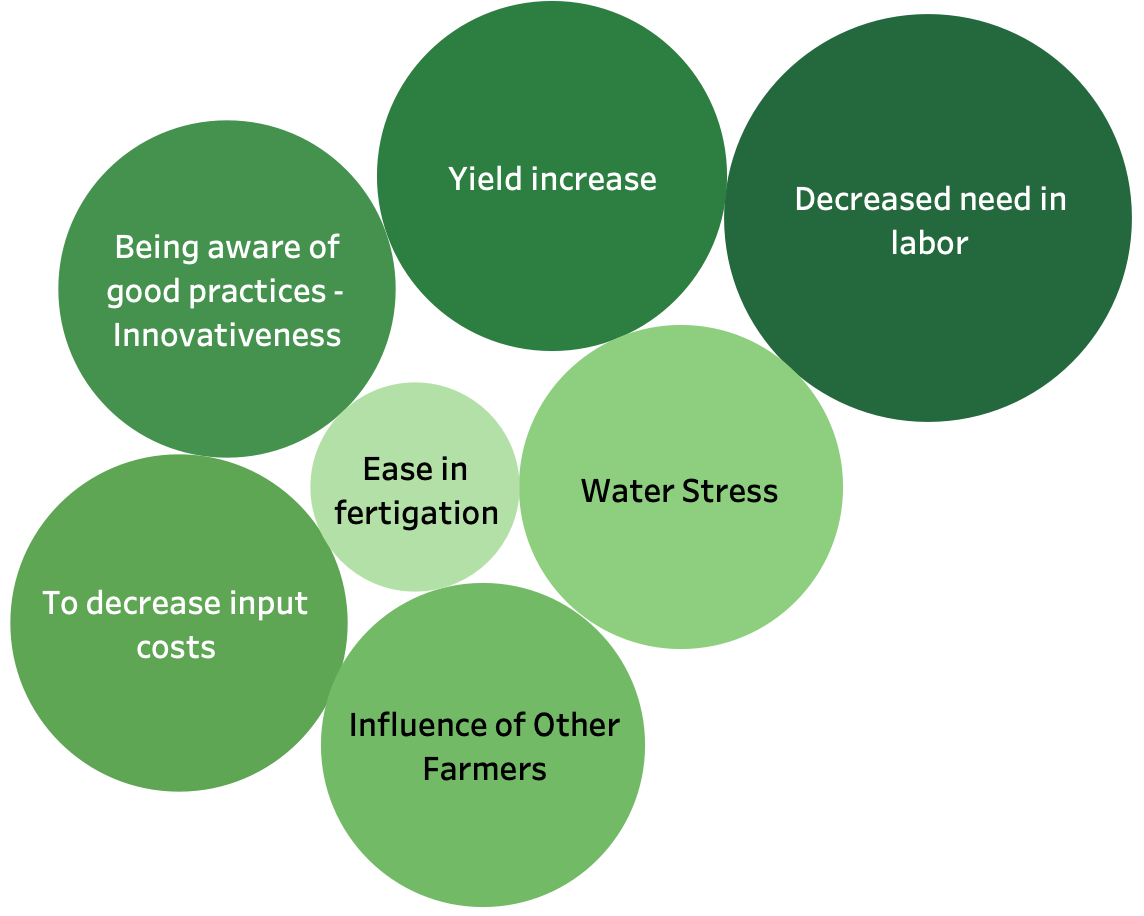
"Decreased need in labor" is the highest-referenced operational motivation for drip adoption (23 refs across 19 sources), exceeding even "ease in fertigation" (7 refs). This is particularly acute in the Southeast where migrant labor is disappearing.
However, the codebook also captures a counter-theme: "Labor Requirement - Inconvenience" as a barrier (7 refs)—the cost and difficulty of installing and removing surface drip pipes seasonally. SDI resolves this as pipes remain permanently underground.
Implication: Labor savings should be quantified and prominently featured in program marketing. SDI should be the default recommendation over surface drip to eliminate the pipe handling labor barrier.
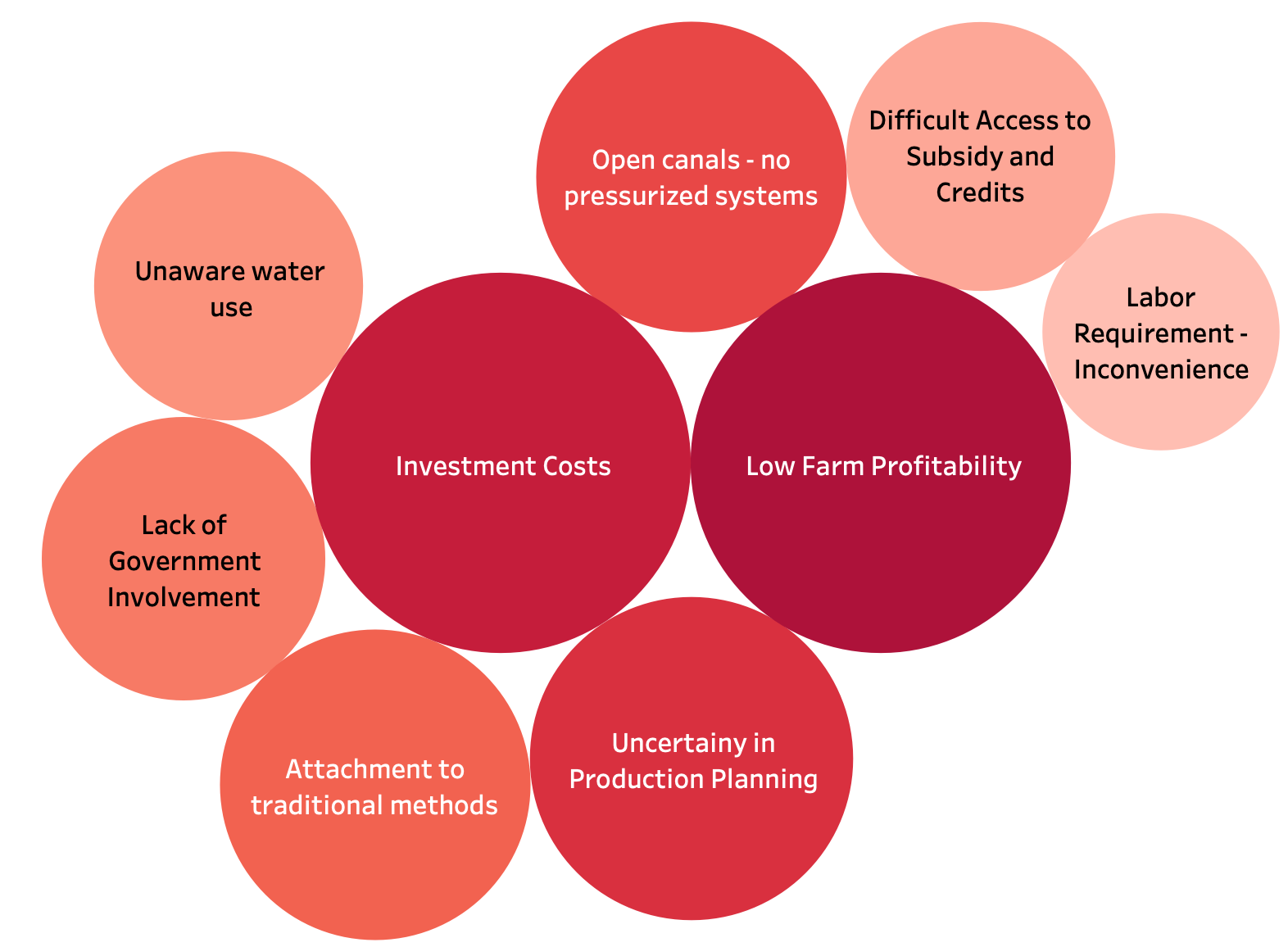
The NVivo codebook identifies "Open canals - no pressurized systems - Energy Access" as the largest infrastructure barrier (20 refs, 12 sources), with sub-codes for additional fuel costs and electricity access difficulties (5 sources each). Additional infrastructure barriers include fragmented land parcels (4 sources), animals destroying pipes (4 sources), and water quality issues in open canals (dirty/salty water requiring expensive filtration).
Water Quality Issues (5 refs)
Open canals cause dirty, particle-laden water that clogs drip emitters and requires expensive filtration. Coastal areas face salt water intrusion. Sub-surface drip with tuzlu (salty) water was actually tested successfully in Kızılırmak—performing better than sprinkler on the same water.
Land Fragmentation (4 sources)
Inheritance-driven parcel fragmentation makes drip investment uneconomical on small plots. "After inheritance, the field gets divided—nobody can earn from it." Land consolidation (toplulaştırma) is identified as a prerequisite.
Implication: Region prioritization (RQ1b) must weight closed canal infrastructure and energy access as critical selection criteria. Programs in open-canal areas will fail without parallel infrastructure investment.
The codebook identifies a distinct behavioral barrier cluster separate from economic or infrastructure barriers. "Excess water use - lack of awareness" alone accounts for 22 refs across 9 sources, making it one of the most pervasive barriers. Many farmers genuinely do not know they are over-irrigating.
Unaware Irrigation (7 refs, 6 sources)
Farmers using flood irrigation often cannot estimate their actual water consumption. "Vahşi sulama" (wild irrigation) persists even in regions with measured water delivery because farmers equate more water with better crops.
Wrong Beliefs About Water (9 refs, 7 sources)
Farmers in rice areas believe continuous flooding is the only way: "We get good yields because we constantly wash the soil." Some believe drip can't adequately saturate roots. In Edirne: "If Meriç dries up, then we'll think about drip."
Crop-Type Misconceptions (7 refs)
Specific beliefs that certain crops cannot be drip irrigated: sprinkler needed before emergence, forage crops incompatible, cereals require overhead water. Some of these have agronomic basis; others are outdated assumptions.
Patriarchy & Expert Distrust (4 refs)
"The final decision comes from my father." Generational authority structures slow adoption even when younger farmers are willing. Combined with distrust of agricultural engineers, creates a knowledge transfer bottleneck.
Implication: Awareness campaigns must address specific misconceptions with local evidence, not generic messaging. "Seeing is believing" demonstration plots are more effective than information campaigns.
Deep tillage is the most contentious practice change, with barriers (74 refs, 36 sources) substantially outweighing motivations (45 refs, 32 sources). The codebook reveals five distinct barrier categories:
Agronomic Constraints (26 refs, 16 sources)
Crop-specific preparation needs (14 refs), pesticide residue burial (4 refs), soil health needs (4 refs), subsoiling requirements (4 refs). These are functional reasons, not mere tradition.
Weed Management (12 refs, 11 sources)
"We visited farmers in Colorado and asked how they solved the weed problem… We don't have access to the same herbicides and machinery." Turkey's restricted herbicide portfolio makes mechanical weed control through tillage a practical necessity.
Behavioral Resistance (23 refs, 17 sources)
Traditional attachment (16 refs) reinforced by education level (5 refs) and distrust of experts (2 refs). "Whatever we learned from father and grandfather…"
Key Motivation: SDI Transition (12 refs, 10 sources)
"With SDI, deep tillage is not needed" (8 refs). The strongest pathway to reduced tillage is through irrigation method change, not direct tillage mandates. Distributors confirm farmers stop deep plowing once they invest in subsurface infrastructure.
Implication: Programs should not mandate tillage elimination as a standalone requirement. Instead, bundle it with SDI adoption where it naturally follows, and develop crop-specific protocols that address agronomic constraints (residue management, weed control alternatives).
Unlike tillage, fertilizer reduction motivations slightly outweigh barriers. The primary driver is rising costs (13 refs, 13 sources). However, behavioral barriers remain significant: traditional attachment (12 refs, 12 sources), education level (5 refs), and distrust of expert recommendations (2 refs).
Typical application rates documented: maize 40–55 kg/da base + 30–50 kg/da top dressing; cotton 30–40 kg/da base + 30 kg/da top; wheat 20–35 kg/da base + 20–40 kg/da top. Drip fertigation already enables more precise application ("They noticed they were applying fertilizer more effectively with drip").
The codebook also captures a unique sub-code: "They reduce fertilizer use with drip anyway" (1 ref)—suggesting that irrigation method change itself drives fertilizer optimization without explicit mandates.
Implication: Fertilizer optimization is the easiest practice change to achieve. Programs should provide soil testing and precision fertigation guidance as a value-added service, framing it as cost savings rather than environmental mandate. Collaboration with seed firms (1 ref) is also identified as a pathway.
A major code family reflecting deep structural frustration. Three sub-categories:
Lack of Government Support (47 refs, 22 sources)
Farmers feel abandoned. Government institutions "don't know much about good practices" (1 ref), rely on private sector "but they're for profit" (2 refs), and prevent necessary research "for political reasons" (1 ref). 10 sources explicitly say "government should support these programs."
Subsidy & Credit Problems (18 refs, 10 sources)
Land ownership barriers to subsidy access (4 sources), limiting requirements (4 refs), excluded costs like transport and installation (1 ref), well registration rules that prevent adjacent parcels from benefiting (3 sources).
Policy Uncertainty (17 refs, 14 sources)
"Government policies are uncertain—they need to align with these necessities" (15 refs, 13 sources). Short-term government decisions (3 refs) undermine long-term agricultural investment. "I don't know what government will do next year."
Government Enforcement as Motivator (8 refs)
Paradoxically, when government does mandate change, it works. The 2nd-crop drip mandate in the Southeast drove rapid adoption. "If the government banned flood irrigation, they'd switch immediately."
Implication: Programs should minimize dependence on government policy stability. Private sector-led structures with government facilitation (not management) are preferred. However, strategic government mandates (e.g., drip requirements in water-stressed basins) can accelerate adoption dramatically.
A distinct code family in the NVivo codebook capturing risks and operational challenges from the implementer perspective, not just the farmer perspective:
Trust Risk (4 refs, 4 sources)
"Risking the trust in case of failure to provide carbon revenue to farmers." If the program promises carbon payments and cannot deliver (due to low carbon prices, verification failures, or credit generation shortfalls), the company's entire brand relationship with farmers is damaged.
Monitoring & Verification (7 refs)
Practice tracking is difficult: "It is hard to track farmers' tillage practices" (3 refs). Data collection intensity and lab costs are high (3 refs). Simultaneous irrigation by many farmers creates monitoring bottlenecks (1 ref).
Farmer Engagement (3 refs)
"Farmers do not listen to irrigation companies' advice other than irrigation." Carbon farming requires changes beyond irrigation (tillage, fertilizer), but companies have credibility only in their core domain. Also: "Farmers struggle to find good information about carbon."
Financial & Operational Risk (5 refs)
Risk of not making profit (3 refs), need for additional personnel (3 refs), operational barriers to scaling across Turkey (2 refs). Being first in carbon farming is both reputational opportunity and financial risk.
Implication: Program design (RQ2) must account for implementer risks, not just farmer economics. MRV costs (RQ3) directly affect program viability. Pilot programs should start regionally to manage operational complexity.
The codebook captures several interrelated sub-themes on how programs build (or lose) credibility:
Clear Offers & Follow-Through (14 refs, 11 sources)
Farmers demand transparency about exactly what is required and what they will receive. Vague promises erode trust. "Just distribution of carbon revenue to farmers" (2 refs) indicates concern about intermediaries capturing value.
Personal Relationships & Distributors (20 refs combined)
Established personal relationships (13 refs, 10 sources) and distributor trust (6 refs) are the strongest trust foundations. Distributors "didn't gain money but it was an opportunity to sell more products"—their incentives align naturally with farmer adoption.
Finding Right Farmers (24 refs, 14 sources)
A specific program design theme about recruitment channels: cooperatives (6 refs), banks (1 ref), machinery suppliers (1 ref), local cafes (1 ref). Strategy: "First with big companies, then cooperatives, then individual farmers." Start with small scale, "then others would see and get familiar" (3 refs).
NGO Role & Limitations (7 refs, 4 sources)
NGOs can help with farmer access (3 refs) and awareness (1 ref), but "NGOs are not very trustworthy in Turkey" (1 ref). Multi-partnered structure needed: "It needs to include STK, university, government, industry, markets, and factories."
A standalone code in the NVivo codebook, distinct from demonstration. Farmers and stakeholders identify a need for structured training programs—not just seeing results, but understanding the underlying agronomic logic.
The FAO representative emphasized that "hibe ve demonstration" (subsidy and demonstration) together drive behavioral change. Training alone is insufficient; it must be paired with financial support and visible proof. Importantly, the new generation is identified as more receptive: "Young farmers are more conscious, but economic problems and climate are barriers."
Implication: Programs should budget for structured extension services, not just one-time enrollment. Collaborate with universities and agricultural chambers for credibility. Target younger farmers as early adopters.
The codebook explicitly codes "Challenge - Low Environmental Concerns" under Program Design. Environmental motivation for drip adoption scored only 18 refs vs. 40 refs for economic motivations and 32 refs for operational motivations. "For benefitting the environment" registers just 1 reference across all interviews.
However, the FAO representative noted Turkey's low soil carbon is actually an advantage—high sequestration potential: "Turkey's soil carbon is very low. Focus on Central and Southeastern Anatolia."
Implication: Programs must not lead with environmental messaging. Frame carbon farming as cost reduction and income generation. Environmental benefits should be communicated as co-benefits, not primary value proposition. "Communicate that you're reducing inputs AND earning money, and oh by the way it's good for the environment."
The codebook identifies specific operational mechanisms that participants believe would make programs viable:
Guaranteed Purchase / Contract Farming (8 refs, 4 sources)
The strongest single mechanism. "Contract farming like Migros or PepsiCo does." Guarantee that the farmer's output will be purchased at a known price, eliminating market uncertainty on top of practice change uncertainty.
Regional Customization (10 refs, 5 sources)
"Not all methods or projects are suitable for all regions—need to be customized." Programs must adapt to local crop rotations, soil types, water infrastructure, and social dynamics rather than apply uniform national templates.
Monitoring & Audit (4 refs)
Participants recognize the need for verification but want it to be non-invasive. Links directly to RQ3 MRV framework design—farmer acceptance of monitoring is a design constraint.
Shared Machinery & Equipment (3 refs)
Access to no-till planters, pipe installation/removal services, and precision equipment. An independent organization managing pipe logistics (1 ref) could address a key labor barrier.
The codebook disaggregates water issues beyond simple "stress" into quality, quantity, and perception sub-themes:
Water Stress / Droughts (19 refs, 17 sources)
The dominant water theme and a key drip irrigation motivator. Groundwater depletion is severe: "Our wells went from 120m to 240m depth." GAP project water, where available, reverses depletion dramatically.
No Water Stress (3 refs, 3 sources)
Thrace and Edirne have adequate water from rivers and reservoirs. These regions have no motivation to adopt drip and are correctly deprioritized in the NVivo region recommendations.
Water Quality Problems (5 refs)
Dirty water in open canals (4 refs) clogs emitters and increases filtration costs. Coastal salinity (1 ref) is a separate challenge. However, SDI field tests with salty water near Kızılırmak showed better performance than sprinkler, suggesting SDI may actually be a solution for salinity-affected regions.
No Water Quality Issue (8 refs)
Most regions with adequate groundwater report good water quality, removing one potential barrier to drip adoption in those areas.
MCDM Criteria Framework for Basin Prioritization
Multi-Criteria Decision Making framework with 6 criteria categories and 17 subcriteria, derived from stakeholder interviews and literature. Used with Fuzzy AHP (weighting) and Fuzzy TOPSIS (ranking) to prioritize agricultural basins for carbon-financed drip irrigation programs.
| Criteria | Subcriteria | Description | Type | Data Source |
|---|---|---|---|---|
| Infrastructure Suitability | Irrigation Infrastructure for Pressurized Systems | Suitability of existing irrigation systems—open or closed canals—for transition to pressurized irrigation | Benefit | Secondary data + classification |
| Energy Reliability for Pressurized Irrigation | Availability and reliability of electricity or energy required for pumping (frequency of cuts, access) | Benefit | Secondary data + classification | |
| Climate Suitability | Water Stress | Level of water scarcity or groundwater stress in the region | Benefit | Secondary data (index) |
| Risk of Irrigation Abandonment | Likelihood that farmers may reduce or abandon irrigation / switch to dryland farming due to water scarcity | Cost | Secondary data + classification | |
| Extreme Weather Event Risk | Frequency of frost, hail, heat waves, or storms that may significantly damage crop production | Cost | Meteorological history | |
| Agricultural System Suitability | Drip Irrigation Transition Potential | Presence of target crops currently irrigated using flood or sprinkler, indicating potential gains from transition to drip | Benefit | Constructed indicator |
| Crop Rotation Compatibility | Extent to which common crop rotations allow continued use of drip irrigation across multiple cycles | Benefit | Constructed indicator | |
| Socioeconomic & Behavioral Readiness | Financial Capacity to Adopt | Presence of farmers with sufficient income / diversified resources to invest in irrigation technologies and absorb economic risks | Benefit | Expert rating |
| Willingness to Avoid Deep Tillage | Farmer openness to reducing or eliminating deep tillage practices, assessed through interview data | Benefit | Expert rating | |
| Willingness to Reduce Fertilizer Use | Farmer openness to optimizing or reducing synthetic fertilizer application, assessed through interview data | Benefit | Expert rating | |
| Environmental Awareness | Presence of farmers motivated by environmental sustainability or carbon emission concerns, receptive to environmentally beneficial practices | Benefit | Expert rating | |
| Operational Feasibility | Farmer Organizations / NGO Presence | Presence of farmer associations, cooperatives, or NGOs that can facilitate outreach, training, and engagement | Benefit | Secondary data + classification |
| Land Consolidation / Big Parcels | Degree of land consolidation or fragmentation, affecting operational feasibility of irrigation technology and contracting | Benefit | Secondary data + classification | |
| Irrigation Technology Market | Presence of irrigation technology providers and personnel for sample data collection | Benefit | Secondary data + classification | |
| Distance to Closest Lab | Distance to laboratories for soil sample analysis and environmental indicators required for MRV | Cost | Secondary data + classification | |
| Social & Environmental Co-Benefits | Social Inclusion Potential | Opportunities to involve women, youth, migrants, or other vulnerable farmer groups | Benefit | Expert rating |
| Environmental Co-Benefit Potential | Potential for additional environmental benefits such as erosion reduction, biodiversity protection | Benefit | Expert rating |
Drip Irrigation: Motivations vs. Barriers
Factors identified by participants as driving or inhibiting the adoption of drip irrigation systems.
Government Support: Loans & Subsidies
Current government mechanisms for pressurized irrigation adoption and their perceived limitations.
Zero-Interest Loans Preferred
Most farmers prefer zero-interest loans over subsidies, citing more practical cash flow management for irrigation investments.
50% Subsidy — But Gaps Remain
The subsidy covers 50% of the investment, but taxes, transportation, and installment costs are excluded. Effective coverage is significantly lower than advertised.
Limiting Requirements
Eligibility criteria and bureaucratic procedures restrict access, particularly for smaller and tenant farmers who face land ownership documentation issues.
Land Ownership Barriers
Many farmers lease land and cannot meet ownership requirements for subsidy eligibility, creating a structural barrier to adoption.
Willingness to Change Practices
Farmer attitudes toward the practice changes required for carbon credit generation: reduced tillage and fertilizer optimization.
Participants identified three potential motivators for reducing tillage: economic motivations (cost savings), soil health concerns (when demonstrated), and the switch to sub-surface drip irrigation (which inherently reduces tillage needs).
However, significant resistance persists due to deeply rooted traditions, perceived yield loss risk, weed management challenges, and agronomic constraints for certain crop rotations.
Rising fertilizer costs are creating an opening for optimization, but strong attachment to traditional methods and yield loss risk perception remain dominant barriers. Farmers express a survival mindset that leaves no room for experimentation.
Program Design Preferences
What participants identified as essential elements for a viable carbon-financed irrigation program.
Economic Gain
Water stress, rising costs, low prices
Risk Mitigation
Yield guarantees, insurance
Willingness
To join carbon program
Feasible Program
Operating & scalable
Contract Preferences
NVivo coding: Contract Requirements and Duration (47 refs, 22 sources). Participant responses on willingness to sign contracts for practice changes.
Preferred Payment Types
Cash
Direct monetary payments
Product
In-kind agricultural inputs
Catalog / Points
Points for seeds, fertilizer, etc.
Reputation
Certification & market recognition
Priority Regions & Selection Criteria
Criteria and specific regions recommended by participants for piloting carbon-financed irrigation programs.
Selection Criteria
- Availability of closed canal systems
- Access to energy for pressurized systems
- Completed land consolidation
- Presence of innovative, open-minded farmers
- Farmers who care about the environment
- Availability of young farmers
- Larger farm sizes
- Good income levels
- Forage crop / livestock activity regions
- Suitable crop types for drip irrigation
- Regions not already using drip widely
- Water-stressed but not at full dry-farming risk
Recommended Regions
Policy Implications
Recommendations for government and program designers based on interview findings.
Strengthen Economic Incentives
Fair pricing, accessible financial support, and practical credit mechanisms to reduce the economic burden of irrigation upgrades on farmers.
Invest in Infrastructure
Closed canal systems in priority hydrological basins are a prerequisite for pressurized irrigation adoption—open canals are a structural barrier.
Reduce Adoption Risk
Yield guarantees or crop insurance mechanisms for conservation agriculture practices. Farmers will not adopt changes they perceive as threatening to survival.
Long-Term Strategy & Collaboration
Carbon farming must be integrated into long-term agricultural strategies with stable policy signals and stronger public–private partnerships.
Causal Loop Diagram
Systems map of the carbon farming adoption system — feedback loops, barriers, and leverage points — derived from 21 farmer interviews across Konya, Adana, and Mardin/Urfa. Open full-page version ↗
References
Aydın, A., Köroğlu, F., Thomas, E. A., Salvinelli, C., Polat, E. P., & Yıldırak, K. (2026). Carbon Farming in Türkiye: Challenges, Opportunities and Implementation Mechanism. Sustainability, 18(2), 891.
Chandra, A. (2024). The water-carbon nexus: is it worthwhile to generate carbon credits based on agricultural water management? Environmental Research Letters, 19(9), 091004.
Gill-Wiehl, A., Kammen, D. M., & Haya, B. K. (2024). Pervasive over-crediting from cookstove offset methodologies. Nature Sustainability, 7(2), 191–202.
Qin, J., Duan, W., Zou, S., Chen, Y., Huang, W., & Rosa, L. (2024). Global energy use and carbon emissions from irrigated agriculture. Nature Communications, 15(1), 3084.
Ministry of Agriculture and Forestry (2022). Water Efficiency Strategy Document and Action Plan (2023–2033).